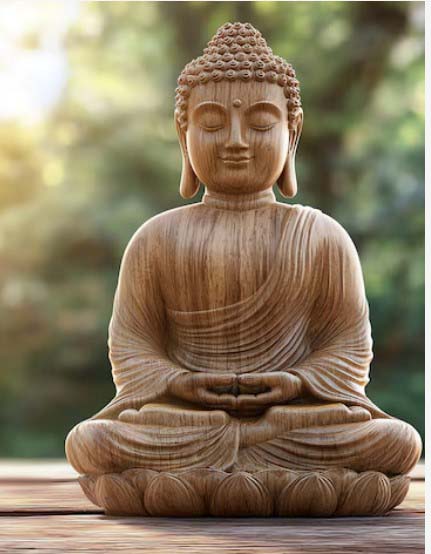
Gautam Buddha, also known as Siddhartha Gautama Buddha is one of the most revered spiritual leaders in history. Born in ancient India he founded Buddhism a religion and philosophy that has influenced millions of people worldwide. His teachings on suffering, enlightenment and the path to liberation continue to inspire seekers of truth even today.
This article explores the life of Gautam Buddha his early years family background, spiritual journey and his profound teachings that transformed the world.
Table of Contents
Early Life and Family Background of Gautam Buddha
Birth and Childhood
Gautam Buddha was born as Prince Siddhartha Gautama in 563 BCE (according to traditional accounts) in Lumbini a small kingdom located in present-day Nepal. His birth is celebrated as Buddha Purnima a major festival in Buddhist traditions.
His father King Śuddhodana, was the ruler of the Shakya clan and his mother Queen Mahamaya was a Koliyan princess. According to legend Queen Mahamaya dreamed of a white elephant entering her womb which was interpreted as a sign that her child would either become a great king or a great spiritual leader.
Tragically Queen Mahamaya died just seven days after Siddhartha’s birth and he was raised by his aunt Mahaprajapati Gautami who became his stepmother.

A Prince’s Luxurious Upbringing
King Śuddhodana wanting his son to become a great ruler rather than a spiritual figure shielded Siddhartha from the harsh realities of life. The prince was raised in immense luxury within the palace walls of Kapilavastu the capital of the Shakya kingdom. He was provided with the finest education, trained in martial arts and surrounded by comfort and pleasure.
At the age of 16, Siddhartha married Princess Yasodhara and they had a son named Rahula. Despite his royal privileges Siddhartha felt a deep sense of dissatisfaction and curiosity about the world beyond the palace.
The Great Renunciation
The Four Encounters
At the age of 29, Siddhartha ventured outside the palace and witnessed four life-changing sights:
An Old Man – He saw the frailty of aging.
A Sick Man – He realized the suffering of disease.
A Dead Body – He confronted the inevitability of death.
A Wandering Ascetic – He saw a monk who had renounced worldly life in search of truth.
These encounters deeply disturbed Siddhartha making him question the nature of human suffering. He realized that wealth and power could not prevent old age, sickness or death.
Leaving the Palace Gautam Buddha
Determined to find a solution to human suffering Siddhartha made the life-altering decision to renounce his royal life. One night he left his sleeping wife and son cut off his hair and gave up his princely robes to become a wandering ascetic. This event is known as the Great Renunciation (Mahabhinishkramana).
The Spiritual Quest and Enlightenment
Years of Austerity and Meditation
For the next six years Siddhartha wandered through forests and studied under various spiritual teachers. He practiced extreme asceticism, fasting and meditation but found that self-mortification did not lead to enlightenment. Realizing that neither luxury nor extreme deprivation was the answer he adopted the Middle Path a balanced approach between indulgence and severe austerity
Attaining Enlightenment (Bodhi)
At the age of 35, Siddhartha sat under a peepal tree (later known as the Bodhi Tree) in Bodh Gaya, vowing not to rise until he found the truth. After days of deep meditation, he finally attained Nirvana (liberation from suffering) and became the Buddha, meaning “the Enlightened One.”
He understood the Four Noble Truths and the Eightfold Path, which became the foundation of his teachings.
Teachings of Gautam Buddha
The Four Noble Truths
- Dukkha (Suffering) – Life is filled with suffering.
- Samudaya (Cause of Suffering) – Desire and attachment lead to suffering.
- Nirodha (End of Suffering) – Suffering can be ended by overcoming desire.
- Magga (Path to End Suffering) – Following the Eightfold Path leads to liberation.

The Eightfold Path
The path to enlightenment consists of:
- Right View
- Right Intention
- Right Speech
- Right Action
- Right Livelihood
- Right Effort
- Right Mindfulness
- Right Concentration
Other Key Teachings
- Karma – Actions have consequences.
- Rebirth – The cycle of birth and death continues until enlightenment.
- Compassion (Metta) – Loving-kindness towards all beings.
- Impermanence (Anicca) – Everything is transient.
Later Life and Death (Mahaparinirvana)
After attaining enlightenment, Buddha spent the next 45 years traveling across northern India, teaching his Dharma (doctrine). He established the Sangha (monastic community) and attracted thousands of followers, including kings, merchantm and common people.
At the age of 80, Buddha passed away in Kushinagar (modern-day Uttar Pradesh, India). His final words were:
His death is known as Mahaparinirvana, marking his final release from the cycle of rebirth.
Legacy of Gautam Buddha
Buddha’s teachings spread across Asia, influencing cultures in China, Japan, Tibet, Sri Lanka, Thailand, and beyond. Today, Buddhism has over 500 million followers worldwide.
Key Buddhist sites, such as:
- Lumbini (Birthplace)
- Bodh Gaya (Enlightenment)
- Sarnath (First Sermon)
- Kushinagar (Death)
Major Pilgrimage Destinations for Buddhists
Buddhism, one of the world’s oldest religions, has numerous sacred sites associated with the life of Gautama Buddha. These pilgrimage destinations hold deep spiritual significance for millions of Buddhists worldwide. The most important among them are the Four Main Pilgrimage Sites (Chardham) linked to key events in Buddha’s life, along with several other revered locations.
The Four Main Buddhist Pilgrimage Sites
According to the Mahaparinibbana Sutta, Buddha himself identified four places that his followers should visit to deepen their faith:
1. Lumbini (Birthplace of Buddha)
📍 Location: Rupandehi District, Nepal
Significance: The sacred garden of Lumbini is where Queen Mahamaya gave birth to Prince Siddhartha in 563 BCE.
Key Attractions:
Maya Devi Temple (marks the exact birthplace)
Ashoka Pillar (erected by Emperor Ashoka in 249 BCE)
Sacred Pond (where Queen Mahamaya bathed before giving birth)
UNESCO World Heritage Site since 1997.
2. Bodh Gaya (Place of Enlightenment)
📍 Location: Bihar, India
Significance: The site where Siddhartha attained enlightenment under the Bodhi Tree and became the Buddha.
Key Attractions:
Mahabodhi Temple (built by Emperor Ashoka)
Bodhi Tree (a descendant of the original tree)
Vajrasana (Diamond Throne) – Where Buddha meditated
UNESCO World Heritage Site since 2002.
3. Sarnath (First Sermon – Dhammacakkappavattana)
📍 Location: Near Varanasi, Uttar Pradesh, India
Significance: Where Buddha delivered his first sermon (Dharma Chakra Pravartana) on the Four Noble Truths and the Eightfold Path.
Key Attractions:
Dhamek Stupa (marks the sermon spot)
Ashoka Pillar with Lion Capital (India’s national emblem)
Mulagandhakuti Vihara (modern temple with murals)
Major center for Theravada Buddhism.

4. Kushinagar (Death & Mahaparinirvana)
📍 Location: Uttar Pradesh, India
Significance: The place where Buddha attained Mahaparinirvana (final liberation) at age 80.
Key Attractions:
Mahaparinirvana Temple (houses a reclining Buddha statue)
Ramabhar Stupa (cremation site)
Matha Kuar Shrine (last sermon location)
A key site for Mahayana Buddhists.
5. Sravasti (Miracle Site)
📍 Uttar Pradesh, India
Where Buddha performed the “Great Miracle” (displaying supernatural powers).
Jetavana Monastery (where Buddha spent 24 rainy seasons).
6. Rajgir (Buddha’s Teachings & Gridhakuta Hill)
📍 Bihar, India
Buddha preached the Lotus Sutra and Heart Sutra here.
Venuvana Vihara (first Buddhist monastery).
7. Nalanda (Ancient Buddhist University)
📍 Bihar, India
One of the world’s first great universities (5th–12th century CE).
Destroyed by invaders in 1193 CE.
8. Sanchi (Great Stupa)
📍 Madhya Pradesh, India
Built by Emperor Ashoka in the 3rd century BCE.
Famous for its Buddhist relics and carvings.
9. Dharamshala & McLeod Ganj (Tibetan Buddhism)
📍 Himachal Pradesh, India
Home of the Dalai Lama and the Tibetan government-in-exile.
Namgyal Monastery and Tsuglagkhang Complex are major attractions.
10. Ajanta & Ellora Caves (Buddhist Art & Monasteries)
📍 Maharashtra, India
Ajanta Caves (2nd BCE–6th CE) – Ancient Buddhist paintings.
Ellora Caves (6th–10th CE) – Rock-cut monasteries.
11. Bagan (Myanmar – Land of Temples)
📍 Myanmar (Burma)
Over 2,000 Buddhist temples from the 9th–13th centuries.
Shwezigon Pagoda and Ananda Temple are highlights.
12. Borobudur (Largest Buddhist Temple)
📍 Java, Indonesia
The world’s largest Buddhist temple (9th century).
A mandala-shaped stupa with 504 Buddha statues.
13. Mount Kailash (Sacred Mountain – Tibetan Buddhism)
📍 Tibet (China)
Considered the abode of Buddha Demchok (tantric form).
A major kora (pilgrimage circuit) destination.