
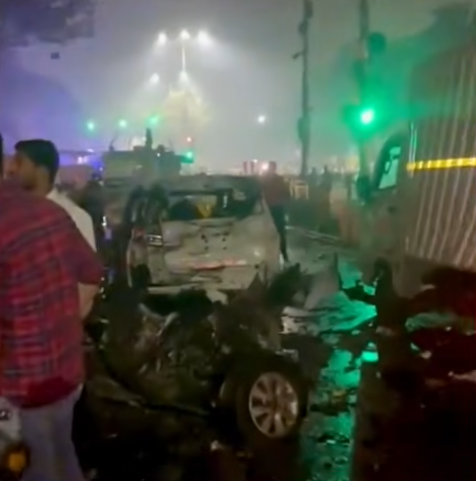
According to police, a car explosion near Red Fort on Monday night left eight persons dead and twenty injured. At 6:52 p.m., a Hyundai i20 exploded close to the Red Fort Metro Station, scattering damaged vehicles and injured bodies throughout the crowded neighborhood. “A slow-moving car that stopped at the Red Fort traffic signal was the scene of the explosion. The automobile was filled with people. Cars in the area were damaged by the explosion, Delhi Police Commissioner Satish Golcha said reporters. Delhi has been placed on high alert. According to the Delhi Fire Services (DFS), 20 fire engines were dispatched to the scene, and the area was cordoned off by police. The Delhi Police Special Cell and anti-terror team are present to evaluate the situation. Images from the scene showed plumes of fire rising from the flaming vehicles. The area, which was crowded with people, was engulfed in panic. The explosion occurred just hours after Jammu and Kashmir Police found about 3,000 kg of explosives in two Haryanan residential structures in Faridabad. The items, which included 350 kg of ammonium nitrate, a common fertilizer that may be used to make a lethal bomb, were recovered based on information obtained from Adil Rather, a doctor who was arrested in J&K.
Table of Contents
Photos From The Delhi Car Blast Show Damaged Cars,
Mangled Bodies This evening, a high-intensity explosion tore through a slow-moving automobile close to Delhi’s iconic Red Fort, killing eight people and injuring twenty. Here is an examination of the

A man from Pulwama, Kashmir, purchased a car used in the Delhi blast.
A guy from Pulwama in Jammu and Kashmir is one of the owners of the Hyundai i20 that exploded Monday night close to Delhi’s Red Fort, killing eight people and injuring twenty more in a startling high-intensity blast, sources informed NDTV hours after the incident. The arrest of Mohd Salman, the original owner of the I-20 with the license plate HR26 CE 7674, was confirmed by police in Gurugram, Haryana. Salman, however, informed the police that he had sold the vehicle to Tariq, a resident of Pulwama, J&K. Whether Tariq subsequently sold the vehicle to a third party is unknown at this time.

NEW DELHI – In the wake of the devastating car bomb attack at the Red Fort, Union Home Minister Amit Shah convened a high-level security review meeting on Thursday evening, delivering a stern message that the perpetrators would be hunted down with “zero tolerance” and hinting at initial intelligence pointing towards a “cross-border terror module.”
Shah’s statement, his first direct address following the attack, sought to project a image of a government in control, even as it faced sharp questions over the security lapse in the high-profile “Red Zone.”
The High-Level Meeting and Key Announcements()
The meeting, held at the Ministry of Home Affairs, lasted for over two hours and was attended by the National Security Advisor (NSA), the Directors of the Intelligence Bureau (IB) and the National Investigation Agency (NIA), the Delhi Police Commissioner and other top security brass.
Emerging from the meeting, Home Minister Shah addressed the media, outlining the immediate government response:
NIA to Lead the Probe: Shah confirmed that the National Investigation Agency (NIA) would be the lead agency in the investigation, underscoring the national security implications of the case. “A special investigation team (SIT) has been formed under the NIA. All resources of the central government are at their disposal to ensure the culprits are identified and brought to justice swiftly,” he stated.

Heightened Security Across the Capital: The Home Minister announced a massive strengthening of the security cordon in the national capital. “We are implementing a multi-layered security grid across Delhi, with a special focus on all iconic landmarks and vital installations. Anti-sabotage checks are being intensified and vehicle checks at all entry points into the city have been quadrupled.”
Acknowledging the Intelligence Gap: In a candid admission, Shah stated that while there were “general alerts” about potential threats, the specific timing and location of this attack were not pinpointed. “Our agencies are working round the clock, but the enemy is constantly evolving. A detailed review of our intelligence mechanisms is underway to plug any gaps,” he said.
Pointing the Finger: The “Cross-Border” Angle
The most significant part of Shah’s address was his strong indication of external involvement. Delhi Red Fort Car Blast While stopping short of naming a specific country or group his language was unequivocal.
“Preliminary forensic evidence and intelligence inputs we have gathered in the last few hours strongly suggest the hand of a cross-border terror module,” Shah asserted. “The design of the explosive device, the modus operandi and the choice of a symbolic national target all bear the familiar signatures of terrorist organizations that operate from our western border. We have seen this pattern before.”
This assertion immediately shifts the geopolitical context of the attack, potentially escalating tensions with neighboring Pakistan. Security analysts suggest that using a VBIED (Vehicle-Borne Improvised Explosive Device) at a high-value target is a tactic long associated with groups like Jaish-e-Mohammed and Lashkar-e-Taiba.

When pressed for details, a senior official from the Home Ministry later clarified, “The ‘cross-border’ link refers to the ideology, planning and possible handlers. The execution may have been carried out by a sleeper cell or freshly indoctrinated module within India. Tracing this local network is our top priority.”
Political Repercussions and a Call for Unity
The Home Minister’s statements did not go unchallenged by the political opposition. Leaders from the Congress and other parties have demanded accountability, calling the attack a “massive failure” of the central government’s internal security policy.
In response, Amit Shah appealed for political unity in the face of the crisis. “This is not the time for political blame gam
NEW DELHI – In the wake of the devastating car bomb attack at the Red Fort, Union Home Minister Amit Shah convened a high-level security review meeting on Thursday evening, delivering a stern message that the perpetrators would be hunted down with “zero tolerance” and hinting at initial intelligence pointing towards a “cross-border terror module.”
Shah’s statement, his first direct address following the attack, sought to project a image of a government in control, even as it faced sharp questions over the security lapse in the high-profile “Red Zone.”
The High-Level Meeting and Key Announcements
The meeting, held at the Ministry of Home Affairs, lasted for over two hours and was attended by the National Security Advisor (NSA), the Directors of the Intelligence Bureau (IB) and the National Investigation Agency (NIA), the Delhi Police Commissioner and other top security brass.
Emerging from the meeting, Home Minister Shah addressed the media, outlining the immediate government response:
NIA to Lead the Probe: Shah confirmed that the National Investigation Agency (NIA) would be the lead agency in the investigation, underscoring the national security implications of the case. “A special investigation team (SIT) has been formed under the NIA. All resources of the central government are at their disposal to ensure the culprits are identified and brought to justice swiftly,” he stated.
Heightened Security Across the Capital: The Home Minister announced a massive strengthening of the security cordon in the national capital. “We are implementing a multi-layered security grid across Delhi, with a special focus on all iconic landmarks and vital installations. Anti-sabotage checks are being intensified and vehicle checks at all entry points into the city have been quadrupled.”
Acknowledging the Intelligence Gap: In a candid admission, Shah stated that while there were “general alerts” about potential threats, the specific timing and location of this attack were not pinpointed. “Our agencies are working round the clock, but the enemy is constantly evolving. A detailed review of our intelligence mechanisms is underway to plug any gaps,” he said.
Pointing the Finger: The “Cross-Border” Angle
The most significant part of Shah’s address was his strong indication of external involvement. While stopping short of naming a specific country or group his language was unequivocal.
“Preliminary forensic evidence and intelligence inputs we have gathered in the last few hours strongly suggest the hand of a cross-border terror module,” Shah asserted. “The design of the explosive device, the modus operandi and the choice of a symbolic national target all bear the familiar signatures of terrorist organizations that operate from our western border. We have seen this pattern before.”
This assertion immediately shifts the geopolitical context of the attack, potentially escalating tensions with neighboring Pakistan. Security analysts suggest that using a VBIED (Vehicle-Borne Improvised Explosive Device) at a high-value target is a tactic long associated with groups like Jaish-e-Mohammed and Lashkar-e-Taiba.
When pressed for details, a senior official from the Home Ministry later clarified, “The ‘cross-border’ link refers to the ideology, planning and possible handlers. The execution may have been carried out by a sleeper cell or freshly indoctrinated module within India. Tracing this local network is our top priority.”
Political Repercussions and a Call for Unity
The Home Minister’s statements did not go unchallenged by the political opposition. Leaders from the Congress and other parties have demanded accountability, calling the attack a “massive failure” of the central government’s internal security policy.
In response, Amit Shah appealed for political unity in the face of the crisis. “This is not the time for political blame gam es. This is a moment for the nation to stand together as one. The enemies of India want to see us divided and fighting amongst ourselves. We must not fall into that trap,” he urged.
He concluded his address with a message of resolve, echoing the Prime Minister’s earlier sentiments: “I want to assure every citizen of India, our security forces will not rest until the entire network behind this cowardly attack is crushed. We will respond to this bloodshed with the full force of the law and our national resolve. Jai Hind.”
As the investigation continues, all eyes are now on the NIA to unravel the conspiracy that has, once again, brought terror to the heart of the capital.


