
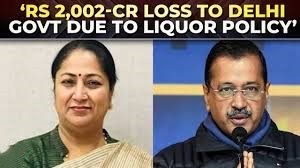
In a major disclosure the Comptroller and Auditor General (CAG) has indicated that the Delhi administration’s 2021-2022 liquor policy resulted in a significant revenue deficit
surpassing ₹2,000 crore. This document, presented in the Delhi Assembly by Chief
Minister Rekha Gupta underscores a succession of policy errors and execution shortcomings that have
led to extensive financial and administrative consequences.
Background of the Excise Policy
the Delhi Excise Policy 2021-22 was launched with grand aspirations to boost state income
eradicates the liquor syndicate and offer a high-end experience for consumers.
Nonetheless, the implementation of the policy was tainted by disputes resulting
in its eventual retraction in 2022. The latest CAG report delivers a thorough
analysis of the policy’s shortcomings and the resulting financial repercussions.
Key Findings of the CAG Report
Revenue Losses Due to Non-Conforming Areas
The policy required the setup of at least two liquor outlets in every municipal ward.
Nevertheless, numerous wards were deemed non-conforming zones where business operations including
alcohol sales face restrictions. According to the CAG report the excise department failed
to obtain the essential approvals from the Delhi Development Authority (DDA) and the
Municipal Corporation of Delhi (MCD) prior to granting licenses. This neglect resulted in legal
disputes prompting the Delhi High Court to exempt license holders in these regions
from paying license fees which precipitated a revenue shortfall of around ₹941.53 crore.

Surrendered Licenses and Lack of Re-Tendering
The report points out that 19 zonal licensees relinquished their licenses before the
policy’s deadline in August 2022. Despite these relinquishments the excise
department did not kick off a re-tendering process to redistribute these zones.
This inaction brought about a notable revenue deficit of approximately ₹890.15
crore as the abandoned zones stayed inactive depriving the state of anticipated
license fees.
Irregular Waivers During the COVID-19 Pandemic
During the outbreak spanning from December 28, 2021, until January 27, 2022,
specific COVID-19 measures were enforced. The excise department provided
exemptions on licensing fees to zonal license holders for this duration. Nonetheless
the CAG report indicates that the tender documents lacked clauses for such
exemptions and internal evaluations implied that these concessions were
unnecessary. The resolution sanctioned by the then excise minister led to an
extra revenue shortfall of about ₹144 crore.
Deviations from Expert Committee Recommendations
A specialized committee was formed to offer suggestions for the forthcoming excise policy.
The committee recommended that wholesale liquor transactions be overseen by a state-run organization to guarantee improved oversight and transparency.
In stark contrast to this recommendation the Group of Ministers (GoM) chaired
by the then Deputy Chief Minister decided to permit wholesale licenses for private
companies. Moreover, the GoM implemented a one-time bidding process
for retail outlets enabling a single operator to manage up to 54 outlets
which is a significant rise from the previously suggested cap of two per individual.
These resolutions sparked worries regarding possible monopolistic behavior
and diminished regulatory scrutiny

Procedural Lapses and Unauthorized Decisions
The CAG report highlights that numerous, decisions with significant revenue consequences
were executed without obtaining the essential approvals from the Cabinet or consulting the
Lieutenant Governor. These actions included concessions for defaulters, exemptions on license fees
and alterations in pricing formulas for imported liquor. Such independent measures
not only violated established procedures but also subjected the administration to
accusations of opacity and mismanagement.
Political and Administrative Repercussions
The release of the CAG report has escalated the political conversation in Delhi.
The Bharatiya Janata Party (BJP) has capitalized on the findings to lambaste the Aam Aadmi Party (AAP)
charging it with financial mismanagement and corruption. Delhi BJP President Virendra Sachdeva
claimed that the former administration intentionally withheld the report to obscure
financial irregularities. In reply AAP’s Leader of Opposition Atishi defended the excise policy
contending that the report’s conclusions were being distorted and that the policy was designed
to reduce corruption present in the previous excise framework.


[…] Pointing the Finger: The “Cross-Border” Angle […]
[…] What was the 2021-22 Delhi Excise Policy? […]