
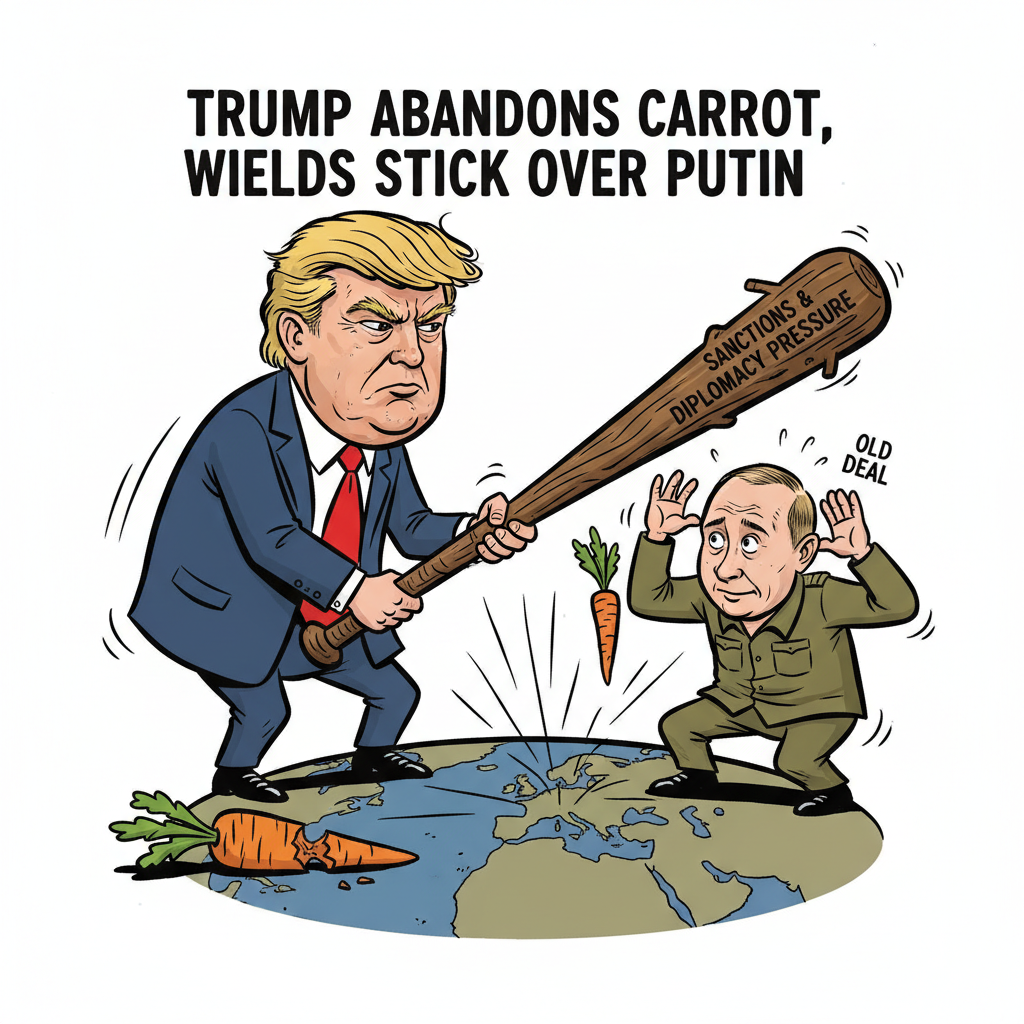
Rosenberg: Trump abandons carrot and wields stick over Trump pressures Putin in Ukraine talks
Analysis: The Kremlin is reeling and friends are cautiously encouraged as the White House adopts a new, uncompromising posture that marks the end of unilateral concessions and a return to a theory of coercive diplomacy.
Washington, D.C. A strategic revolution that is readjusting the most significant geopolitical confrontation in the world is taking place in the quiet, gilded corridors of the Oval Office. A complicated, frequently conflicting dance of diplomacy and deterrence has defined Washington and Moscow’s relationship over the bloody war in Ukraine for years. However, Kremlin insiders, European diplomats and top administration officials say a fundamental and significant change has taken place. The “carrot and stick” strategy as detractors have called it, is no longer in use instead the stick is being used as a decisive tool of policy rather than as a threat.
This new, harder American posture is the biggest hardening of the U.S. attitude since the first Russian tanks crossed the border and insiders are subtly referring to it as the “Rosenberg Doctrine” after its key author, National Security Advisor Samuel Rosenberg. The previous administration’s strategy of pursuing a negotiated settlement through unilateral goodwill gestures has come to an end and in its place. it has adopted a strategy of increasing real pressure aimed at forcing Vladimir Putin to the negotiating table from a position of extreme weakness.
The change was conveyed through a series of harsh, purposeful measures over the past month, rather than through a prime-time speech or a presidential tweet. The Kremlin is currently frantically trying to come up with a response, while America’s European friends are expressing a sense of sad, relieved consensus.
Table of Contents
From Carrots to Concrete: The Evolution of a Stalemate Trump pressures Putin
The prior strategy, which dominated the second part of the previous term, was based on a de-escalation hypothesis. It included delaying some long-range weaponry, making vague references to possible future sanctions release and having private talks that frequently appeared to ignore the Kyiv government of Ukraine. Supporters contended that it avoided a risky, direct conflict between NATO and Russia and maintained channels of communication with Moscow. A bipartisan majority in Congress and important NATO allies were among the critics who viewed it as a kind of appeasement that gave Putin more confidence, enabled him to solidify his territorial gains, and extended the misery of the Ukrainian people.
Speaking on condition of anonymity to discuss sensitive policy discussions a senior State Department official told this reporter that the previous strategy was founded on a fundamental error. We believed that Putin was a logical person who would react to rewards. We provided rewards. He escalated after pocketing them. He saw restraint as a sign of weakness. Now, that calculus is permanently changed.

According to officials the collapse of the strategically important town of Avdiivka in February marked a turning point. The White House viewed the Russian triumph, which was attained by overwhelming artillery and human wave attacks as a direct result of Western hesitancy rather than merely a tactical defeat. Rosenberg and his supporters believed that Ukraine had lost the initiative because of the delayed supply of F-16s and the drawn-out discussions about ATACMS missiles.
The official stated, “Advika was the last piece of proof we needed.” It demonstrated that taking short cuts would only lead to a deadly, drawn-out standoff that benefited Putin. The president was given a clear option: allow Ukraine to prevail or accept a frozen conflict that validates Russian dominance. He went with the latter option.
The Architecture of the “Stick”: A Multi-Front Assault on Kremlin Power
The Rosenberg Doctrine is not a single program rather it is a coordinated, multifaceted pressure campaign that is carefully planned to target the three main pillars of Putin’s power: his economic stability, his military apparatus and his reputation abroad.
1. The Military Pivot: Unleashing Ukraine’s Arsenal
The area of military assistance is where the change is most obvious. The transfer of military systems that the White House had earlier considered too escalatory has been accepted and actively supported after months of opposition.
Long-Range Strike Capability:
The United States has now provided Ukraine with a sizable quantity of 190-mile-range ATACMS missiles. Devastating results have already been achieved with these weapons. which damaged two Russian military ships in a dry dock in Sevastopol, Crimea, and hit a command centre in seized Luhansk. Due to this, Russia has been forced to relocate its air defines systems, supply depots and command headquarters far from the front lines, which has reduced their efficacy and drastically altered the battlefield calculation.
F-16 Operational Green Light:
The first Ukrainian-piloted F-16 squadrons are now flying from facilities in Romania and Poland following a year of training. These fourth-generation fighters are threatening Russia’s air superiority over the Black Sea while not flying directly over Russian-held territory. They are also acting as a powerful screen against Russian drones and cruise missiles. Plans for the employment of these aircraft in “counter-terrorism operations” against military targets inside Russia’s acknowledged borders a red line that was once untouchable have also been pre-approved by the administration.
Advisor Surge:
Officially designated for “logistical support and maintenance training,” a group of several hundred U.S. military advisors has been sent to western Ukraine. Even though the administration maintains that they are far from areas of conflict, their presence shows Moscow how committed Washington is and signifies a major increase in American commitment.
2. The Economic Vise: Sanctions with Teeth
At the same time, proactive sanctions enforcement has replaced reactive enforcement by the Treasury and Commerce Departments.
Secondary Sanctions on Banks:
The United States has started to impose secondary sanctions on financial institutions in third countries, namely in China, the United Arab Emirates and Central Asia. that enable transactions for Russian defence companies or assist Moscow in evading current sanctions a move long desired by European allies. More than any other step, this “name and shame and penalize” strategy poses a threat to the Kremlin’s access to the international financial system.
Targeting the Inner Circle:
Several of Putin’s closest oligarchs, even those who were once thought to be untouchable, have had their personal assets and family members directly sanctioned for the first time. The purpose of personalizing financial suffering is to incite conflict among Putin’s closest circle, transforming his most important supporters from assets into liabilities.
The Energy Gambit:
In an effort to permanently shift European gas imports away from Russia, the United States has significantly expanded its political and financial backing for alternative energy projects in Central Asia and the Caucasus, falling well short of a complete embargo. The objective is to permanently destroy Russia’s main economic influence over Europe.
3. The Diplomatic Offensive: Isolating Russia
American diplomacy has overcome its ambivalence on the international scene. With dossiers of data showing Russian war crimes and a stark choice: support the international order or participate in its destruction, Secretary of State David Chen just wrapped up a tour of countries in the Global South, including Brazil, South Africa and India.
A top assistant to Secretary Chen said, “We are demanding they select a side; we are no longer begging for their understanding.” “The days of moral equality are ended. A victim and an offender are present. Our partners are increasingly aware that their position on Ukraine will determine the terms of their future security and economic ties with the United States.
The Kremlin’s Reaction: From Swagger to Stunned Silence
Moscow’s initial response has been a mix of bravado and obvious bewilderment. There is a noticeable air of unease when state television propagandists, who previously made fun of Western disunity, suddenly rant about “American warmongers.” Putin has simply made a general caution about “asymmetric responses” in public, which is a significant change from his earlier claims of Russian superiority.
Dr. Anya Petrova, a senior fellow at the Centre for Strategic and International Studies who has connections inside the Russian foreign ministry, stated, “They are rattled.” “American policy in the past was foreseeable. They were able to control it. They do not have a playbook for their new position. The notion of a protected rear area has been destroyed by the strikes that have occurred far within Crimea and now Russia proper. In contrast to earlier rounds, the financial fines are already beginning to have an impact. The Kremlin is on the defence for the first time in a long time.
Speaking on background a European intelligence official agreed. “Our intercepts show that the Russian Ministry of Defense is in serious distress. The destruction of the dry dock at Sevastopol was a significant practical and symbolic setback. They are now compelled to reevaluate the Black Sea Fleet’s overall security. Negotiating from this position of strength is not appropriate.
The Allies: A Sigh of Cautious Relief
The change has been greeted with a collective, if circumspect, sigh of relief in European capitals. Leaders like Olaf Scholz of Germany and Emmanuel Macron of France have been treading carefully for the past two years, matching American help while anxiously observing Washington’s erratic posture. Now that the United States is playing a strong, leading role, they have the authority to increase their own contributions.
“Our biggest weakness was the unknown,” a senior German defence official acknowledged. There is now a well-defined plan. Although it is a risky tactic, it is nonetheless a tactic. We can now completely coordinate our efforts with Washington and determine the direction of travel. This has enabled the alliance as a whole to provide a new degree of financial and military assistance.
The Road Ahead: Peril and Possibility
There are risks associated with the Rosenberg Doctrine. It significantly escalates the stakes and the possibility of a direct, disastrous conflict between NATO and Russia, according to critics, including several retired generals and foreign policy realists.
Charles Wicker, a former diplomat and Cold War negotiator, cautioned, “We are playing with fire.” There is a counter-escalation for every escalation. We are putting Putin in a difficult position by approving attacks within Russia and specifically targeting his inner circle. The most dangerous player on the international scene is an autocrat who is surrounded and armed with nuclear weapons.
Furthermore, continued Western unity is very necessary for the concept to succeed. An economic slowdown in Europe, a shift in the political climate in America or a successful Russian misinformation operation may all cause the coalition to fall apart. Additionally, the policy is a huge bet on Ukraine’s capacity to quickly take advantage of this fresh backing and produce significant military victories in the upcoming months.
However, there is a noticeable feeling in Washington, Brussels and Kyiv that the initiative is changing for the first time since the beginning of the invasion. The “stick” of unyielding pressure has taken the place of the “carrot” of negotiated compromise. Finding a way out of the situation without looking foolish is no longer the message to the Kremlin rather, it is about enforcing a price so high that further aggression is no longer viable.
After rejecting the carrot, the world now watches and waits to see if the guy in the Kremlin will eventually give in to pressure or decide to break both himself and the newly forged steel of a united West. The path has been established by the Rosenberg Doctrine. Whether it leads to a just peace or a more perilous chasm will be decided in the upcoming months.


